Curious about what the magnitude of the electric field e(r) is at a distance r>rb from the center of the ball? Let’s delve into the fascinating world of physics to unravel this intriguing mystery. Understanding the behavior of electric fields is crucial in various scientific applications. By exploring this concept, we can gain valuable insights into the fundamental forces that shape our universe. So, buckle up for an enlightening journey into the realm of electromagnetism!

Understanding the Electric Field at a Distance from the Center of a Ball
Imagine a ball, a perfectly round and smooth ball. Now, let’s delve into the world of science and explore the fascinating concept of the electric field surrounding this ball. Specifically, we will unravel the mystery of what happens to the magnitude of the electric field at a distance greater than the ball’s radius from its center. Let’s embark on this electrifying journey together!
The Basics of Electric Fields
Before we dive deeper into the electric field surrounding a ball, let’s first grasp the fundamentals. An electric field is an invisible force field that surrounds electrically charged objects. It exerts a force on other charged objects within its vicinity. Simply put, it’s like an invisible magnet that can attract or repel charged particles.
Electric Field around a Charged Object
Now, let’s focus on the electric field around our spherical ball. When an object is charged, it creates an electric field around itself. This electric field extends outward from the charged object in all directions. The strength of this electric field decreases as you move farther away from the charged object.
Magnitude of the Electric Field at a Distance r from the Center of a Ball
As we move away from the center of the ball, the electric field’s magnitude changes. At a distance r from the center of the ball, the electric field’s strength, denoted as E(r), is determined by the ball’s total charge and the distance r.
Calculating the Electric Field at a Distance r from the Center
To calculate the electric field at a distance r from the center of the ball, we need to consider the ball’s charge distribution. If the ball has a uniform charge density, the electric field at distance r can be calculated using the formula:
E(r) = k * (Q / R^3) * r
Here, k is Coulomb’s constant, Q is the total charge of the ball, R is the radius of the ball, and r is the distance from the center. This formula helps us determine how the electric field strength varies with distance.
Electric Field Behavior Beyond the Ball’s Radius
Now, let’s explore what happens to the magnitude of the electric field when we move beyond the ball’s radius. When the distance r is greater than the ball’s radius (r > R), the electric field’s behavior undergoes some intriguing changes.
Decrease in Electric Field Strength
As we move further away from the center of the ball, the electric field strength diminishes. This decrease is due to the spreading out of the electric field lines over a larger area. Think of it like a flashlight beam becoming fainter as you move away from its source.
Inverse Square Law
The decrease in electric field strength beyond the ball’s radius follows the inverse square law. According to this law, the strength of the electric field is inversely proportional to the square of the distance from the center of the ball. In simple terms, as you double the distance from the center, the electric field strength decreases by a factor of four.
Application of the Inverse Square Law
Understanding the behavior of the electric field at a distance from the center of a ball is not just a theoretical exercise; it has practical applications in various fields.
Electrostatic Shielding
One practical application of the behavior of the electric field beyond the ball’s radius is electrostatic shielding. By placing a conductive shell around a charged object, the electric field inside the shell becomes zero. This phenomenon, known as electrostatic shielding, demonstrates how the electric field’s behavior can be manipulated to control the flow of charges.
Wireless Power Transfer
Another application of understanding the electric field behavior is in wireless power transfer technology. By manipulating the electric field strength and direction, engineers can design efficient systems for wirelessly transmitting power over long distances.
In conclusion, exploring the magnitude of the electric field at a distance from the center of a ball opens up a world of scientific wonders. From understanding the basics of electric fields to delving into the intricacies of the inverse square law, the journey through the electric field realm is both enlightening and captivating. Next time you see a ball, remember the invisible electric field surrounding it, waiting to be explored and understood. Let’s continue our quest for knowledge and unravel the mysteries of the electric field together!
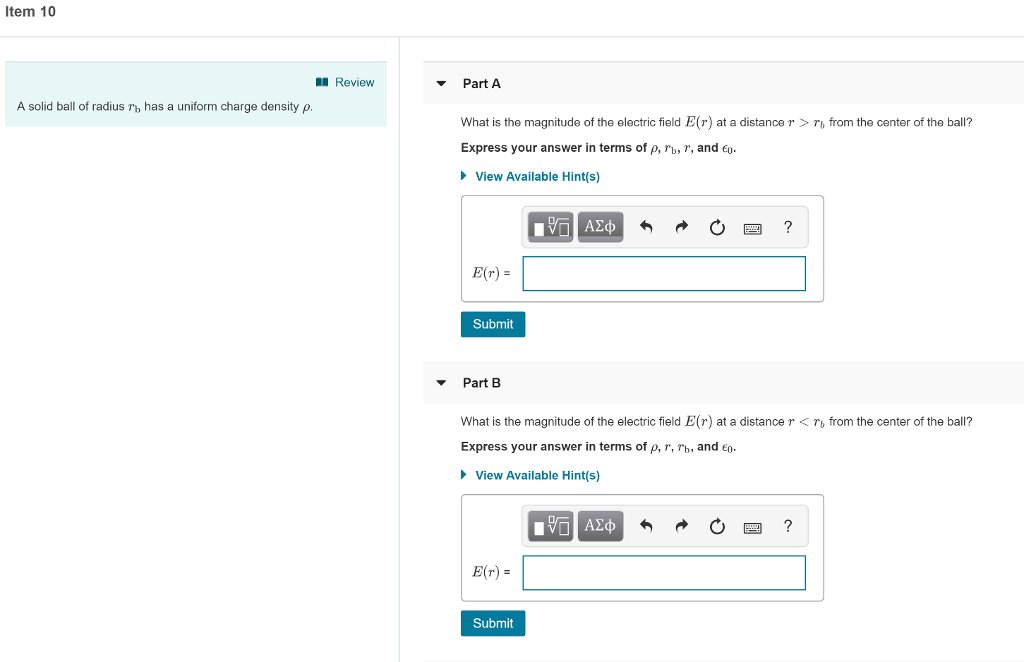
A solid ball of radius rb has a uniform charge density ?. What is the magnitude of the electric fie…
Frequently Asked Questions
What factors determine the magnitude of the electric field at a distance greater than rb from the center of the ball?
The magnitude of the electric field at a distance r from the center of the ball depends on the charge distribution within the ball and the distance r.
How does the magnitude of the electric field vary with distance from the center of the ball?
The magnitude of the electric field decreases as the distance r increases from the center of the ball due to the inverse square law relationship between electric field strength and distance.
Can the electric field at a distance r > rb from the center of the ball be calculated using Coulomb’s law?
Yes, the electric field at a distance r greater than the radius of the ball can be calculated using Coulomb’s law by considering the charge enclosed within a sphere of radius r.
What effect does the charge distribution within the ball have on the electric field magnitude at distances beyond rb?
The charge distribution within the ball influences the electric field magnitude at distances greater than rb by affecting how the electric field lines extend beyond the surface of the ball.
How does the size of the ball impact the magnitude of the electric field at distances larger than rb?
The size of the ball affects the magnitude of the electric field at distances beyond rb since a larger ball with a different charge distribution will generate a different electric field pattern compared to a smaller ball.
Final Thoughts
In conclusion, the magnitude of the electric field e(r) at a distance r>rb from the ball’s center crucially depends on the charge distribution and geometry of the ball. Understanding this relationship allows for precise calculations of the electric field strength in different scenarios. When evaluating the electric field at a distance r>rb, consider both the charge enclosed within the radius r and the distribution of charge within the ball. This comprehensive approach ensures an accurate determination of the electric field strength at varying distances from the center of the ball.